
A Philosophy Of Musical Interpretation For Flutists
When Sound Becomes Meaning
By Yulia Berry
A philosophical book on musical interpretation for performers seeking structural clarity, artistic responsibility, and intellectual depth.

What Does It Mean for Sound to Become Meaning?
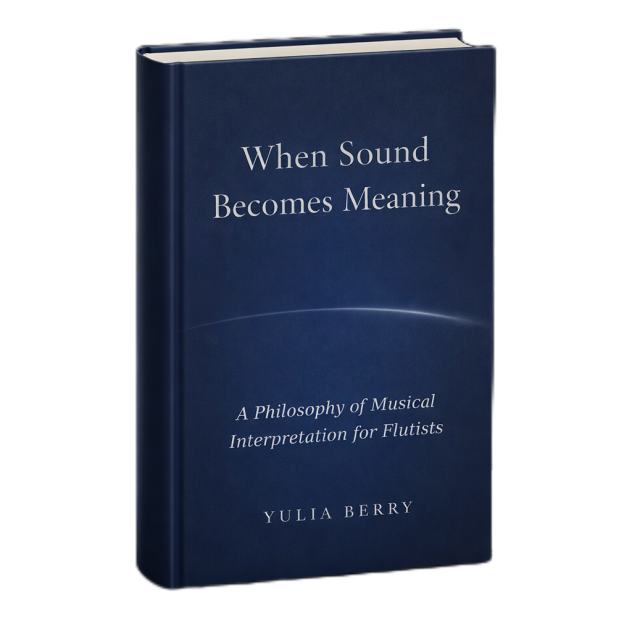
When Sound Becomes Meaning is a philosophical book by Yulia Berry exploring the foundations of musical interpretation for flutists.
Music does not begin as meaning. It begins as vibration — physical, measurable, neutral.
Meaning arises only when sound is shaped by structure, directed by intention, and guided by artistic responsibility.
For performers, this transformation is not automatic. It requires awareness of phrase architecture, harmonic direction, rhetorical gesture, breath shaping, release, articulation, and timbral intention.
Technique alone does not produce coherence. Expression without structure risks dissolving into sentiment. True interpretation emerges when these dimensions align.
When Sound Becomes Meaning explores the conditions under which musical sound acquires direction, coherence, and intellectual integrity.
It proposes that interpretation is not an emotional reaction, but a disciplined act of listening — an alignment of structure, intention, and responsibility.
This book is written for flutists and serious musicians who seek not only to play beautifully, but to understand when sound carries meaning — and how to shape it with intention.
THE POSITION
On Musical Meaning: Six Principles
This book does not propose a method
Interpretation is not emotion
Structure is not restriction
Intention is not impulse
Technique is not meaning
Responsibility is musical
Who This Book Is For
- For the performer who senses that fluency is not enough — and that something essential is missing beneath polish.
- For the teacher who seeks a language for artistic responsibility beyond mechanics and routine.
- For the musician who understands that interpretation must be grounded in structure, intention, and ethical awareness.
- For those who do not merely want to play beautifully — but to understand what beauty demands of them.


Yulia Berry, DMA
“Sound alone is vibration. Meaning emerges when structure, intention, and responsibility align. My work examines this alignment — where sound becomes meaning.”

Yulia Berry
ABOUT THE AUTHOR
Yulia Berry, DMA, is a flutist, educator, and founder of international flute initiatives devoted to elevating artistic standards in performance and pedagogy. Her work centers on the philosophical foundations of interpretation — examining how structure, listening, and responsibility shape musical meaning.
When Sound Becomes Meaning represents the culmination of decades of performance, teaching, and sustained reflection on the intellectual discipline underlying artistic expression.
Architecture of the Book
Table of Contents
When Sound Becomes Meaning unfolds in six philosophical movements.
Each part explores a different dimension of musical interpretation, gradually moving from the nature of sound itself toward the deeper question of why artistic creation exists at all.
Sound
Structure
Perception
Inner Life
Responsibility
Meaning

Why Meaning Matters in Flute Playing
Establishes the central question: under what conditions does sound acquire meaning?
1. Beyond the Instrument
The Inner Education of the Musician
Examines musical development as inward formation, not mechanical training.
2. Pulling the Sound
The Art of a Living Tone
Explores tone as directed energy rather than produced vibration.
3. The Artistic Voice of the Flute
Timbre, Emotion, and Expression
Investigates color as expressive identity rather than surface effect.
4. Technique as Musical Language
Why Scales Matter
Repositions technical work as structural literacy.
5. Intervals and Inner Hearing
How Musical Distance Shapes Meaning
Studies interval as tension, relationship, and expressive logic.
6. Tone in Motion
Vibrato and the Art of Release
Analyzes movement within sound as a principle of direction and dissolution.
7. Music as Rhetoric
The Architecture of Phrasing
Frames phrasing as thought shaped through breath.
8. Articulation and Meaning
Musical Punctuation and Responsibility
Examines attack and separation as interpretive decisions.
9. From Affects to Expression
The Evolution of Musical Emotion
Traces historical and philosophical shifts in emotional articulation.
10. Sound and Silence
The Discipline of Leaving Space
Considers silence as structural presence rather than absence.
11. The Aware Performer
Stage Presence, Focus, and Fear
Explores awareness as the foundation of stability in performance.
12. When the Self Outplays the Music
Ego, Identity, and Artistic Humility
Confronts the tension between personal identity and musical service.
13. Reverence and Responsibility
The Ethics of Listening
Articulates interpretation as an ethical act grounded in attentiveness.
14. The Quiet Despair of the Unseen
Examines the inner cost of creating without recognition and the discipline required to remain faithful.
Recognition and Distortion
Explores how visibility reshapes artistic intention and how integrity withstands validation.
Creation as Participation
Reframes artistic work as contribution to a larger continuity rather than individual assertion.
Generosity and Return
Considers giving as the foundation of artistic exchange and the unseen reciprocity embedded in creation.
Courage Without Spectacle
Defines bravery in art as steadiness and truth rather than performance or display.
Belonging
Investigates the artist’s place within tradition, community, and shared meaning.
Why We Create at All
Articulates creation as necessity — not ambition, but alignment with something beyond the self.
When Sound Becomes Meaning
Now Available
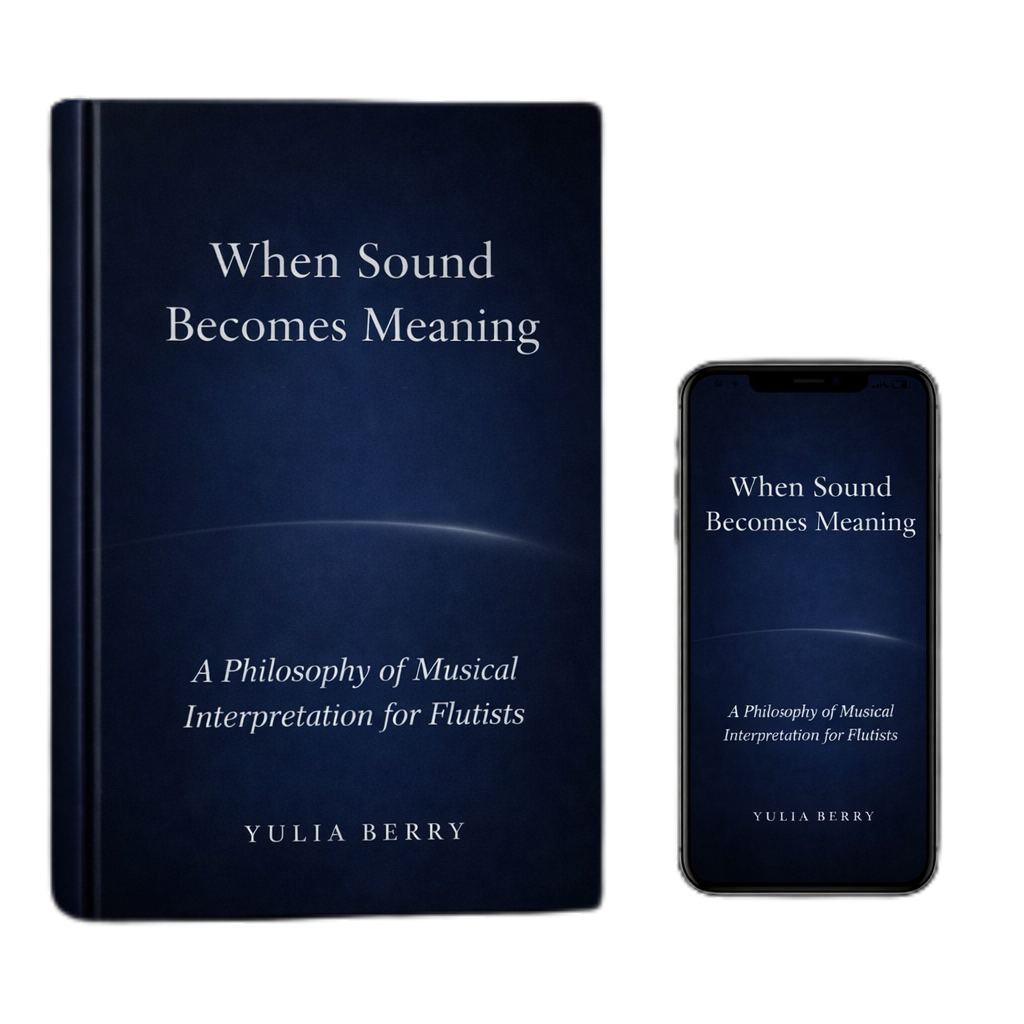
The First Edition (Digital)
The first edition of When Sound Becomes Meaning is presented as a carefully structured digital volume — the first formal articulation of its philosophical architecture.
This work examines sound not as vibration alone, but as directed meaning — shaped through structure, breath, listening, and artistic responsibility.
Digital access upon purchase


The Foundation of a Long-Term Artistic Legacy
When Sound Becomes Meaning establishes a philosophical framework for flute interpretation — integrating tone, rhetoric, structure, perception, and artistic responsibility into a unified discipline of artistic thought.
This is not a method. It is an architecture.

A Philosophical Position
Why this book was written
In contemporary flute performance, technique has advanced to an extraordinary level. Precision, speed, projection, and control are cultivated with rigor. Yet as technical mastery has intensified, a quieter question often remains unexamined: What gives sound meaning?
This book was written in response to that question.
Over years of teaching and performing, a recurring imbalance became clear — a devotion to execution without equal attention to philosophical grounding. Interpretation is frequently discussed in terms of expression, yet rarely articulated as a disciplined alignment of structure, intention, listening, and responsibility.
Modern pedagogy offers methods — exercises and systems. What it rarely offers is a coherent framework that unites tone, rhetoric, perception, breath, and ethics into a single architecture of thought.
When interpretation is detached from structure, expression becomes sentiment.
When technique is detached from intention, virtuosity becomes display.
When sound is detached from responsibility, performance loses coherence.
When Sound Becomes Meaning addresses this gap. It does not propose a method. It articulates a position — restoring philosophical grounding to contemporary performance.
GET IN TOUCH
Scholarly Correspondence:
Yulia Berry, DMA
Author of When Sound Becomes Meaning
Boston, United States